
Tell us about yourself and how you are involved with FIRST?
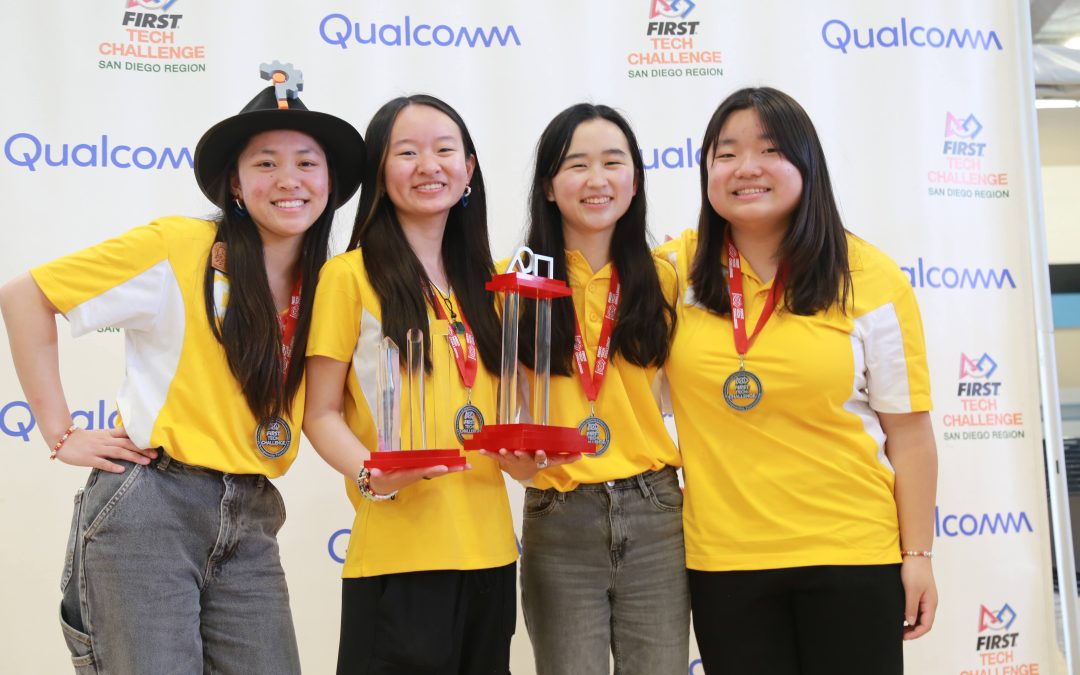
Hi! I’m Danielle, Co-Captain of FTC team The Clueless #11212. My time in FIRST started in 3rd grade when I competed in FL L. In elementary school, robotics practice consisted of playground breaks longer than working time, scootering around the black top, and chatting in Google Docs comments rather than focusing on innovation project meetings—robotics practice was not exactly my favorite place to be. Why was I spending hours every week with a robot that couldn’t even drive straight on its own? Alas, I decided I liked FIRST robotics enough to power through a gloved, masked, and Zoom-interaction-only middle school FLL in my garage. I’ve spent the last 4 years mentoring FLL teams and teaching camps, and 9 years later, I’m still here!
More recently, I’ve co-led The Clueless to become World Champions, world record setters, and 2x Worlds Inspire Finalists. I was also a Dean’s List finalist last year.
My role on The Clueless has been to create team structure, consistent communication, and organization to keep the team aligned across technical and nontechnical subteams. I’ve spearheaded our community impact initiatives to maximize the impact we have with our platform, as well as led recruitment, external relations, and fundraising efforts.
How has FIRST helped you accomplish your goals?
In many ways, FIRST has been my goal. It has been my dream since my elementary school days in the playground to qualify for the FIRST World Championships. My 7th-grade FLL team came pretty close when we took 2nd overall at the SoCal championship—only for Worlds to have been canceled for COVID. It wasn’t until my sophomore year of high school when The Clueless won San Diego’s Winning Alliance Captain that I had my first opportunity to go.
As I’ve approached “unc” status in FIRST, my focus has shifted away from trying to win awards to giving the opportunity FIRST gave me to others. I’ve founded and championed programs like IGNITE Robotics, which exposed over 4K students to FIRST, taught hundreds, and ultimately created 8 FTC teams in South Africa; the largest FTC mentorship network to date, with over 120 participating teams; and Robotics Without Borders, which collected over 150 unused EV3 (FLL) robots and redistributed them to students in need globally.
As often as I contemplate and plan for the “what do you want to be when you grow up?”, my answer and my goals change. Fortunately, the skills learned through FIRST will last a lifetime and any version of my future life. I’ve not only developed technical skills to build robots, products, and life-changing innovations—I’ve developed soft skills; interpersonal skills. FIRST teams cultivate skills I never knew I had: the ability to resolve conflict, foster team culture, communicate effectively, and lead a team.
Do you recall any special experiences or challenges?
I have many fond memories throughout my time in FIRST—yelling over the announcers and music as the human player on the World’s Finals stage, practicing our presentation and Q&A in the airport, many boba runs (unfortunately not on the team budget), “sleepovers” on the foam tile field, 6 elementary schoolers
 running up to hug me at their FLL practice, among numerous others. However, what makes FIRST the most special to me is the people. Through FIRST, I’ve met some of my best friends and have been able to see firsthand the impact of the work we do. From walking the pits at Worlds with a girl from South Africa, who I sent EV3 robots—to seeing teams on opposite ends of the world engage as mentors and mentees … these are the experiences I now chase.
In a hyper-competitive environment of dwindling college acceptance rates, it’s easy to be distracted by fancy awards and titles to build a 99-page-long resume. It’s easy to read the award rubrics and spin a story that checks the boxes of “exemplary.” It’s easy to muddle the numbers and “impact” thousands through social media numbers—which, by the way, as a FIRST team, you’re mostly followed by other FIRST teams.
However, I’ve challenged myself (and now I challenge you) throughout my nearly decade in FIRST to shift my purpose and motivation to continuously learning, growing, and impacting others. I challenge you to re-evaluate why you’re in FIRST and what you want to do with the platform and community FIRST provides. I challenge you to develop long-term, sustainable initiatives—not ones that will appear the prettiest for judging sessions, but ones that will change someone’s life.
Why do you think FIRST is important for females?
Despite the initiatives, movements, and progress, we live in a world where females are differentially treated. Even within the robotics sphere, this persists. FIRST provides a training ground to help girls navigate and overcome these biases—with communities like FIRST Like A Girl to empower females through their struggles.
What are your goals for the future?
I don’t exactly know what I want to be in the future—but at least FIRST has taught me who I want to be. Gracious Professionalism sounds silly at first when you learn to recite an answer to “wHaT dOeS gRaCiOuS pRoFeSsIoNaLisM mEAn tO yOu” in your sleep. But after a decade of this indoctrination from FIRST, I find that this does resonate with me—and that it’s the philosophy I want to live by in future competitions, work, and life.
I plan to double major in mechanical engineering and business because I love the interdisciplinary role I ended up in with FIRST—seeing the big picture across technical and nontechnical subteams. I want to build technologies and build communities optimized to help the most people.
What advice would you give to the younger generation of girls interested in STEAM fields?

Take opportunities when you get them—there are many female-identifying exclusive programs like SWE, BE WiSE through the Fleet Science Center, and EDGE at UCSD for various age ranges. Check out what opportunities you have local to you; the last two in my list are in the San Diego area. Don’t be afraid to enter co-ed spaces. Surround yourself with people and mentors who believe in you and your abilities.
If and when you encounter situations where you feel pushed aside or discounted, stay true to yourself. If that space is where you want to be, if it’s what you love doing, then fight for it. In some way, shape, or form, find a way to continue in that sphere, even if it means leaving a team to found your own.
Lastly, when it feels like there are no open doors to you, make your own. Start a club, a robotics team, or a passion project—and become that trailblazer for yourself and other girls to find their love and aptitude for STEM.
 Do you know a student, alumni, mentor, volunteer or sponsor with a great story?
Click here to nominate your favorite #FIRSTLikeAGirl, to tell her story!